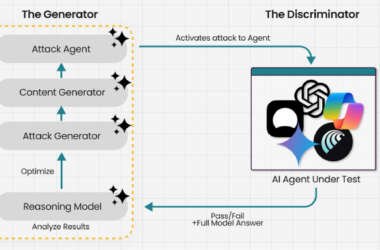




In this article, we will provide a brief overview of Pillar Security’s platform to better understand how they are tackling AI security challenges.
Pillar Security is building a platform to cover the entire software development and deployment lifecycle with the goal of providing trust in AI systems. Using its holistic approach, the platform introduces new ways of detecting AI threats, beginning
Category: Data Breaches
Your blog category
-

Product Walkthrough: A Look Inside Pillar’s AI Security Platform
-

Apple Patches Safari Vulnerability Also Exploited as Zero-Day in Google Chrome
Apple on Tuesday released security updates for its entire software portfolio, including a fix for a vulnerability that Google said was exploited as a zero-day in the Chrome web browser earlier this month.
The vulnerability, tracked as CVE-2025-6558 (CVSS score: 8.8), is an incorrect validation of untrusted input in the browser’s ANGLE and GPU components that could result in a sandbox escape via -

Google Launches DBSC Open Beta in Chrome and Enhances Patch Transparency via Project Zero
Google has announced that it’s making a security feature called Device Bound Session Credentials (DBSC) in open beta to ensure that users are safeguarded against session cookie theft attacks.
DBSC, first introduced as a prototype in April 2024, is designed to bind authentication sessions to a device so as to prevent threat actors from using stolen cookies to sign-in to victims’ accounts and gain -

Chaos RaaS Emerges After BlackSuit Takedown, Demanding $300K from U.S. Victims
A newly emerged ransomware-as-a-service (RaaS) gang called Chaos is likely made up of former members of the BlackSuit crew, as the latter’s dark web infrastructure has been the subject of a law enforcement seizure.
Chaos, which sprang forth in February 2025, is the latest entrant in the ransomware landscape to conduct big-game hunting and double extortion attacks.
“Chaos RaaS actors initiated -

How the Browser Became the Main Cyber Battleground
Until recently, the cyber attacker methodology behind the biggest breaches of the last decade or so has been pretty consistent:
Compromise an endpoint via software exploit, or social engineering a user to run malware on their device;
Find ways to move laterally inside the network and compromise privileged identities;
Repeat as needed until you can execute your desired attack — usually -

Cybercriminals Use Fake Apps to Steal Data and Blackmail Users Across Asia’s Mobile Networks
Cybersecurity researchers have discovered a new, large-scale mobile malware campaign that’s targeting Android and iOS platforms with fake dating, social networking, cloud storage, and car service apps to steal sensitive personal data.
The cross-platform threat has been codenamed SarangTrap by Zimperium zLabs. Users in South Korea appear to be the primary focus.
“This extensive campaign involved -

Why React Didn’t Kill XSS: The New JavaScript Injection Playbook
React conquered XSS? Think again. That’s the reality facing JavaScript developers in 2025, where attackers have quietly evolved their injection techniques to exploit everything from prototype pollution to AI-generated code, bypassing the very frameworks designed to keep applications secure.
Full 47-page guide with framework-specific defenses (PDF, free).
JavaScript conquered the web, but with -

CISA Adds PaperCut NG/MF CSRF Vulnerability to KEV Catalog Amid Active Exploitation
The U.S. Cybersecurity and Infrastructure Security Agency (CISA) on Monday added a high-severity security vulnerability impacting PaperCutNG/MF print management software to its Known Exploited Vulnerabilities (KEV) catalog, citing evidence of active exploitation in the wild.
The vulnerability, tracked as CVE-2023-2533 (CVSS score: 8.4), is a cross-site request forgery (CSRF) bug that could -

⚡ Weekly Recap — SharePoint Breach, Spyware, IoT Hijacks, DPRK Fraud, Crypto Drains and More
Some risks don’t breach the perimeter—they arrive through signed software, clean resumes, or sanctioned vendors still hiding in plain sight.
This week, the clearest threats weren’t the loudest—they were the most legitimate-looking. In an environment where identity, trust, and tooling are all interlinked, the strongest attack path is often the one that looks like it belongs. Security teams are -

Email Security Is Stuck in the Antivirus Era: Why It Needs a Modern Approach
Picture this: you’ve hardened every laptop in your fleet with real‑time telemetry, rapid isolation, and automated rollback. But the corporate mailbox—the front door for most attackers—is still guarded by what is effectively a 1990s-era filter.
This isn’t a balanced approach. Email remains a primary vector for breaches, yet we often treat it as a static stream of messages instead of a dynamic,